Ghosts in the Shell
In August 2000, Tajai and Yameen, recording under the alias SupremeEx, met with journalist Peter Babb in Oakland to publicly debut their first collaboration album, Projecto: 2501, in a special cover story for XLR8R Magazine.
The conversation ranged from artificial intelligence (as it was understood in 2000) and predicting what we now call deepfakes to anticipating the dot-com bust before it happened, as well as discussions of cloning, cybernetics, the democratization of technology, the ethics of innovation, maintaining a healthy skepticism toward emerging tech, and even plans for an ice capades show featuring holographic talking heads.
Presented below is the complete, unedited conversation. To read the article as it was originally printed in XLR8R magazine, click here.
Cyber-Optic Sounds
XLR8R, Cover Story
“Fusing Music with New Visual Media”
Issue 46, December 2000
Interview by Peter Babb
Listen to the full conversation:

Origin of Fable
XLR8R: I gotta start off about the basics, about how this project started to come together, what the timeline was.
Yameen: It was March of last year [1999] and my boy Jack Boog approached me; he was putting a compilation together for Bobbito’s Footwork Illadelph store in Philly. And he was like, “Why don’t you get one of the Hieros to rhyme over a beat for a little interlude?” Of course I was like, “Cool,” so I asked Tajai if it would be cool and he said yea.
So I sent him two beats and it was supposed to be just a skit, but he sent me back a whole song. And that song would become “Authentic Intelligence.”
Tajai called me back a couple weeks later and said, “Let’s do a whole album based off of that song,” and we started doing that in, like, April?
Where did the whole concept come from of The Entity and SupremeEx?
[Spontaneous laughter ensues.]
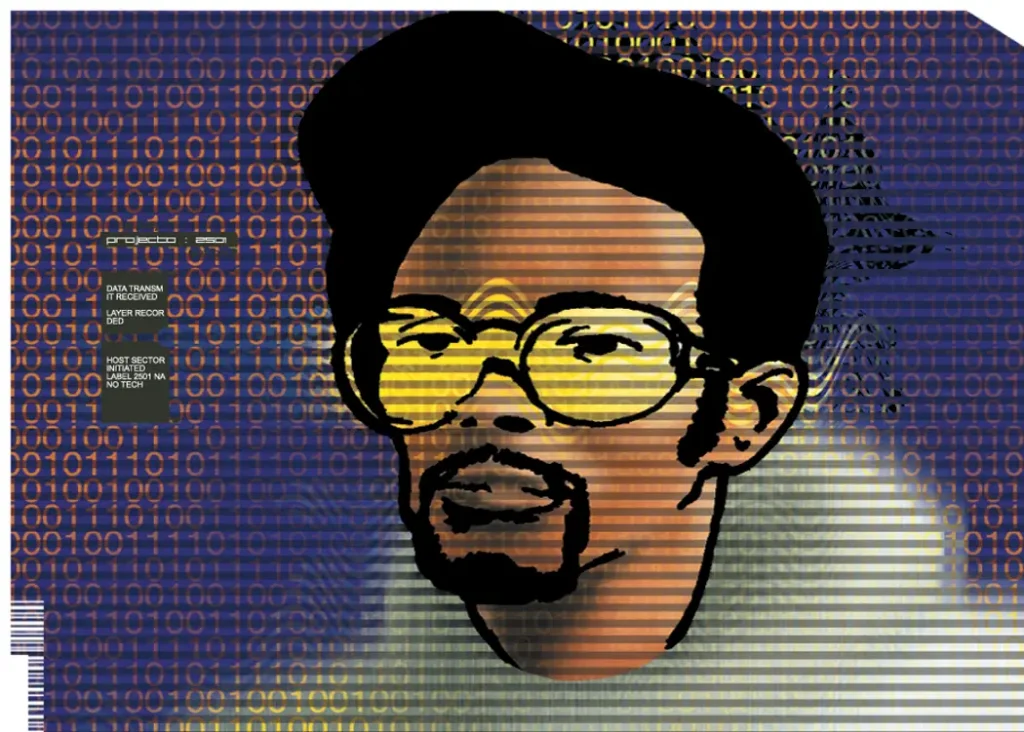
Y: “SupremeEx” has been a conceptual musical alias of mine for two or three years now. So the beats that I sent Tajai were already “SupremeEx.”
In the beginning of “Authentic Intelligence,” it has a little vocal sound clip [prefacing the story], so we sprung off from that.
Shing02 and Major Terror came in later on and we began to adapt them into the storyline…And then I think we were mixing the album when we decided to do trading cards?

Cards Against Humanity
The trading card thing is kind of dope too…How about the idea of making the full package of the artwork and the trading cards, or how everything contributes to the source? Nobody’s really done that yet.
Y: It just seemed intuitive to me…
Tajai: Yea, it just kind of went along with the whole concept. It’s like: the music is vivid, but we still wanted to enhance it, you know, make people understand that it’s more than just the music.
Hopefully, eventually, we’ll be able to expand beyond trading cards into actual figurines and stuff like that.
NPC Energy
Yameen, you did all the beats. Who did the scratching on the record?
T: JayBiz from Hiero. Then DJ Nozawa, he’s Shing02’s DJ. And then DJ Low Budget, from Philly, came in and added some stuff to it.
What was it like for you, Tajai, writing rhymes as a character instead of just writing rhymes as Tajai?
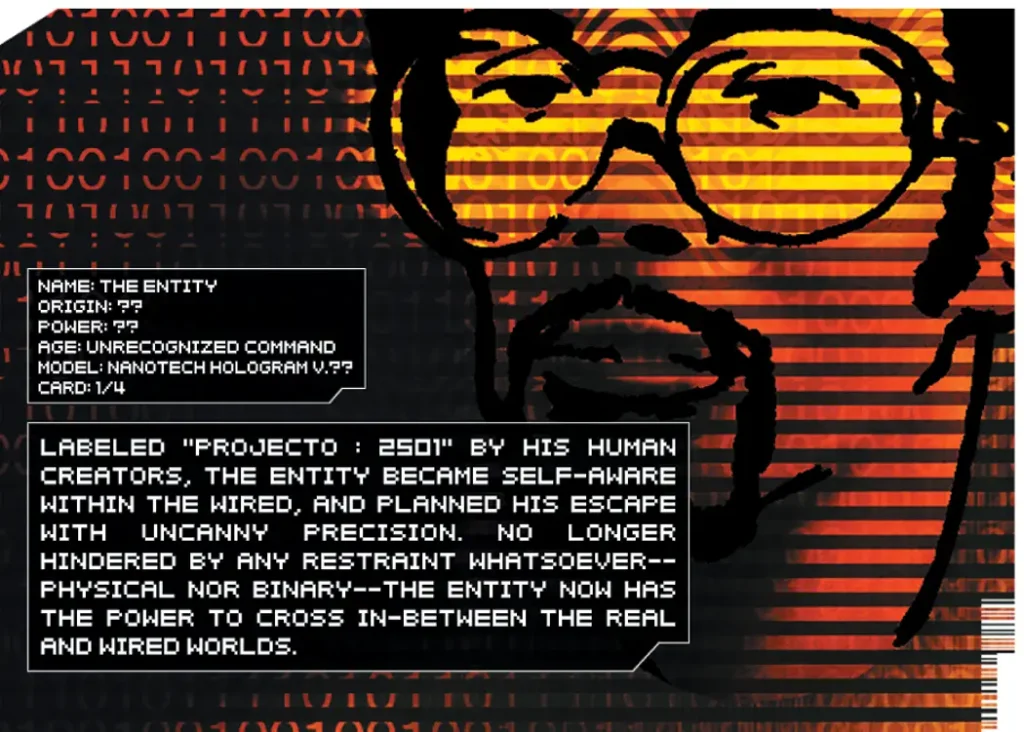
T: It’s more…Man, it’s fun. You get to…not experiment — I mean, I experiment a lot just in general — but it’s just fun because I try to have so many characters that I am never out of character doing something. So, being The Entity is fun because he’s not human. He’s like a new life form taking new stuff in.
Getting into that perspective is fun. When we first started developing the storyline, it helped me figure out what his perspective is. Yea, I like messing with characters.
World.exe
The storyline, you just took it from that sound clip and messed around with it?
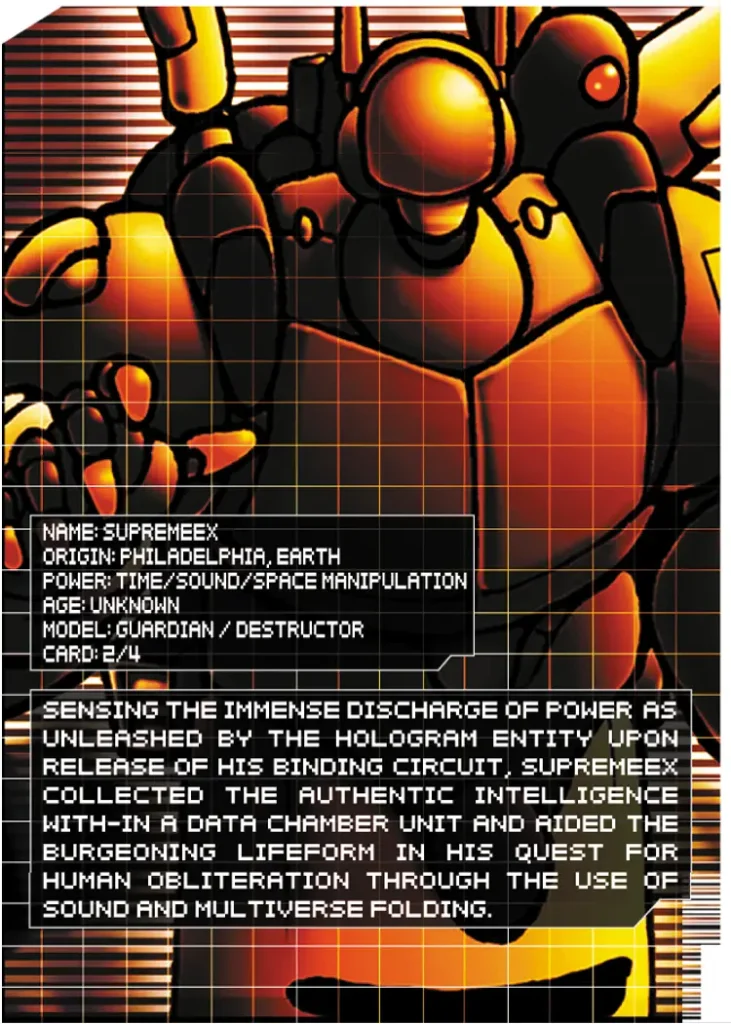
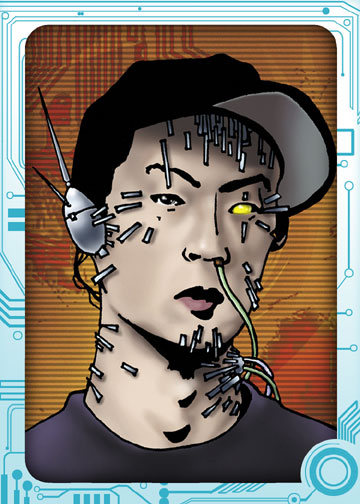
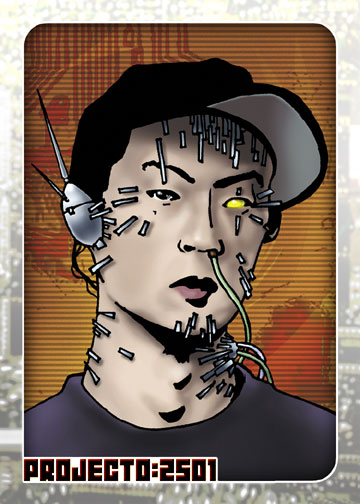
Y: Yea, as we progressed in the development of the record, we took a lot of time to fully develop the back stories for each character, most of which you will not even know or hear about on the actual music part of the record, but we list some of their fictional histories on the trading cards.
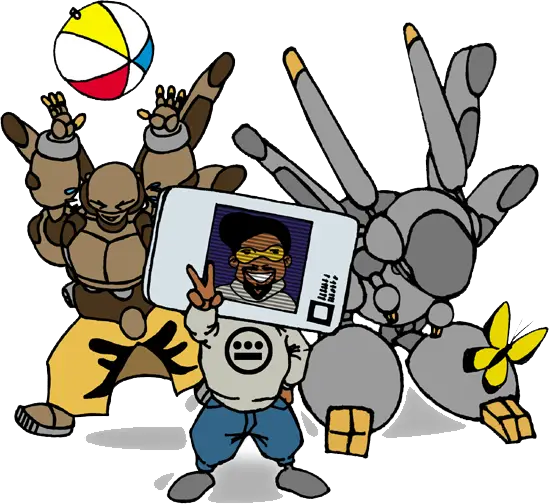
And this is where illustrator Colm Doherty helped out a lot too in developing the characters’ stories. And that was just important for us to understand where these characters are coming from while we were drawing them and developing the characters. In all, it was a very involved process.
The artwork took a very long time. I think we kind of perfected what we wanted to do in that regard.
How did the artwork collaboration with illustrator, Colm Doherty go down?
Y: We met on the Hiero Hoopla message board on Hieroglyphics.com.
He and I were trading something—we were trading anime VHS tapes. And he sent me a letterhead, and it had a lot of designs on it, and I asked him where it came from. And he said, “Oh, I drew it.” And then he sent me a flyer with a character on it, and I thought to myself, “This would be perfect for what Tajai and I were working on.” This was really early on in the project. But, I thought his style of art would fit with what we were doing.
So I intentionally kept it on the low and didn’t tell Colm the details about the collaboration with Tajai yet because I’m superstitious about shit until it’s finished, so I asked Colm, “How about you draw a character for SupremeEx?”
I think we took maybe a month and a half making SupremeEx, and once it was finished, I knew his illustrative style would adapt to what Tajai and I were doing. And then I broke him down with the details about the project, and the collaboration with Tajai, and he came in full-time after that, bouncing ideas back and forth.
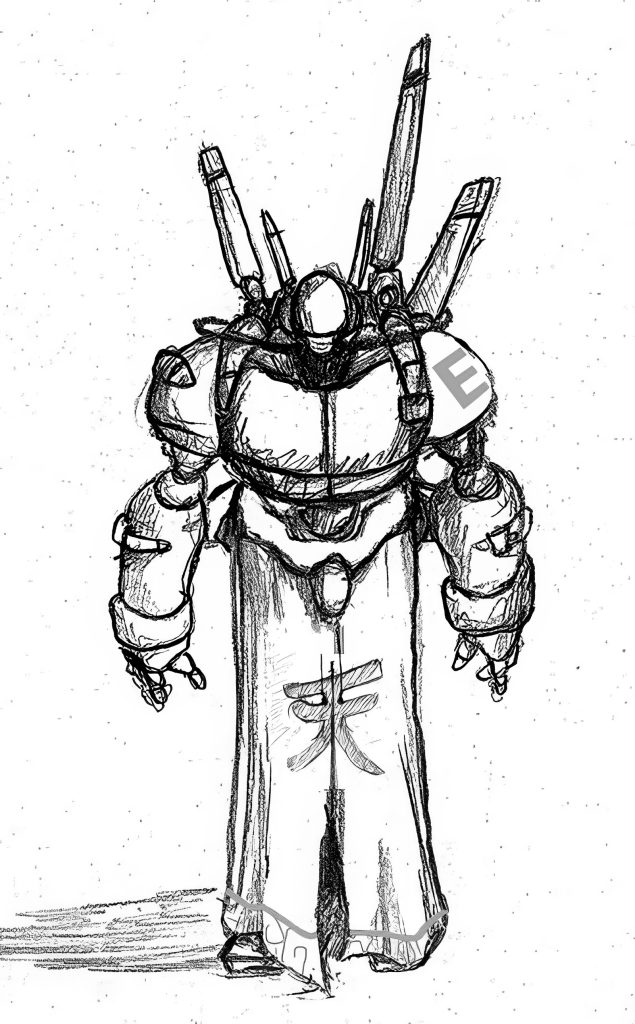
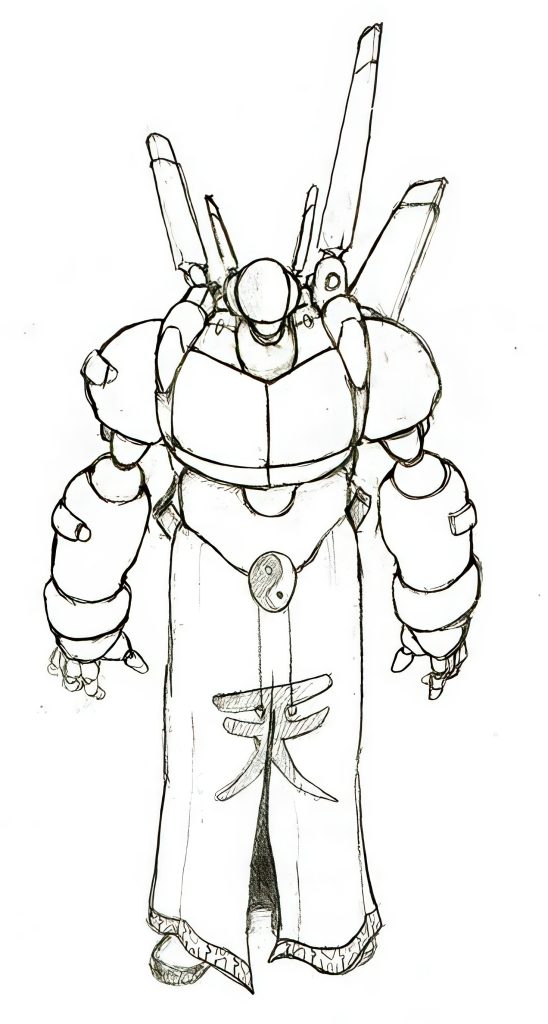

I only spoke with that cat once, over the telephone. It was all through email. He would draw something, I would look at it. “Fix this, fix this.” I would make little marks in Photoshop and send it back to him. He would make the changes, send it back to me.
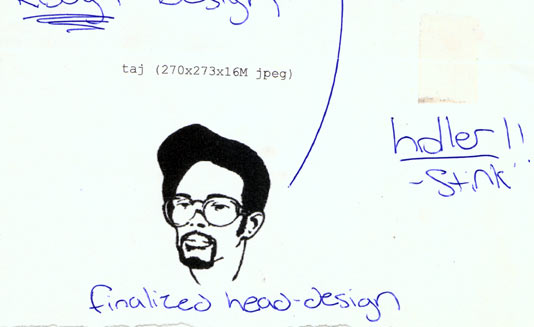
Editor’s note: In 1999, remote creative collaboration over the Internet was still a relatively new concept, enabled by faster modem connections and the growing accessibility of software like Photoshop.
Authentic Intelligence
Talk to me about A.I. now — about the whole idea of artificial intelligence taking its own physical form instead of being locked into circuits.
T: I thought about it as thought energy, where the right “things” combine, and the right elements combine, and the right sequence of events happen and you get Creation. And so that’s what I think of as “A.I.”
It’s not really a big database or something where you ask it a question and it refers to a database. There’s an extra element that is added. I mean, if we could figure it out we’d be making them…But that’s sort of how I want The Entity to be.
It’s like what I say on the second song, “Origin of Fable”: Things you would call genies or ghosts or viruses or anything, they have their own sort of consciousness. And they are basically energy that has converged at the right time and created itself, or rather defined itself.
Do you feel we are actually moving in that direction with technology today?
T: Yeah, I think so.
Y: Especially with nanotech. Here’s something we cannot visibly see, but it can replicate itself. For instance, if you drop a nanotech shell over in that corner, theoretically, it could build a structure or a building by itself.
T: Yea, you may have to provide the raw materials, like drop it on a pile of rocks and it’ll make concrete out of it and starts filling in a structure. That’s on a level you can’t observe everything. So even the parts where you can’t observe or control, there’s some other stuff going on.
Even how they say computers and networks talk to each other when they’re not being used. That’s stuff you can’t really control; it’s beyond your control.
Do you feel A.I. will eclipse human consciousness at some point? It seemed like that was where it was going on the album.
T: When you look at just how you need a car to get around and things like that, you know what I mean? It has sort of incorporated itself.
Basically, everything we do right now is technology-based. There’s a few things — like martial arts and stuff like that — based on human power. But with the other stuff, we are sort of controlling it, but it’s not our power.
So it hasn’t eclipsed us, but it has integrated itself into our being. Regardless of if we are cybernetic or anything. But to an extent, you have to hop in a car to get food. Or, more bluntly, people don’t grow their food. You have to transport it through machines, harvest it by machines, and all that kind of stuff.
The Net is Vast & Infinite
Are you going to promote this online too?
Y: Yea, now that the album is wrapping up we’re going to do a whole web onslaught and formally announce it and take it from there. We don’t really know what’s going to happen.
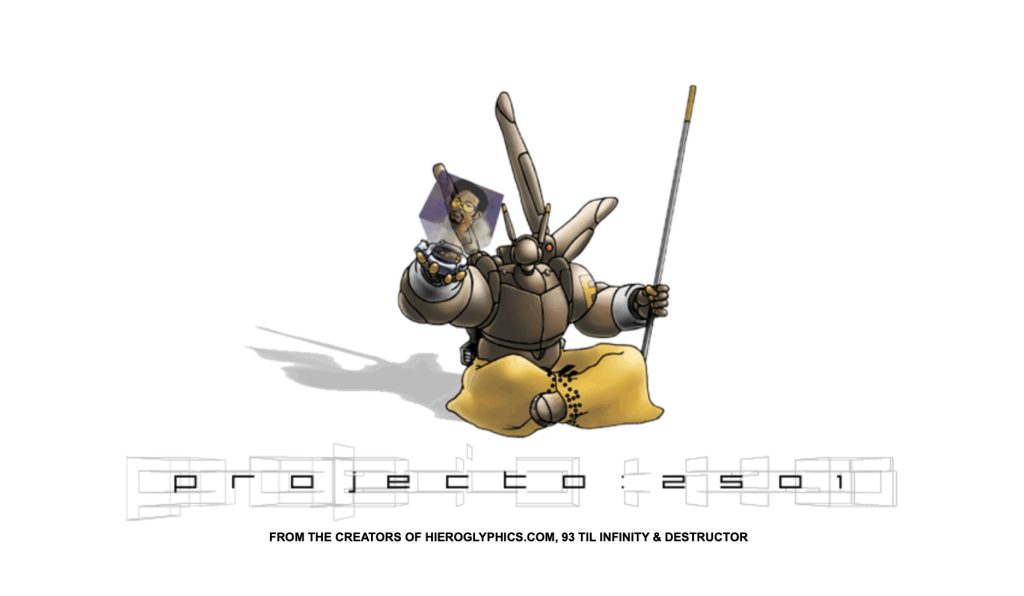
Right, because there’s the reputation now, with Hiero and everything, that it’s the new generation of the internet rapper and all of that.
T: We’re going to have it in stores too. But we’re going to also try and make sure its presence is felt online as well. That’s where a lot of support is going to come from: a lot of people who are open to different kinds of music, who would be down to come and pick it up.
So do you think you’re going to continue the story after the release?
[Laughter.]
Y: We’re working on the next one right now!
T: It’s a full-length though, a full-length. We’re trying to make it like chapters.
How many?
T: Maybe like 10…I’M SHOOTING FOR 10!
[Laughter.]
T: That’d be a good body of work. But then with all of the characters — we’ve got Cowboy, and Shingo and Terror — and Shingo and Terror are artists too. So we could have like, you know how Wolverine will have a separate graphic novel? Stuff like that.



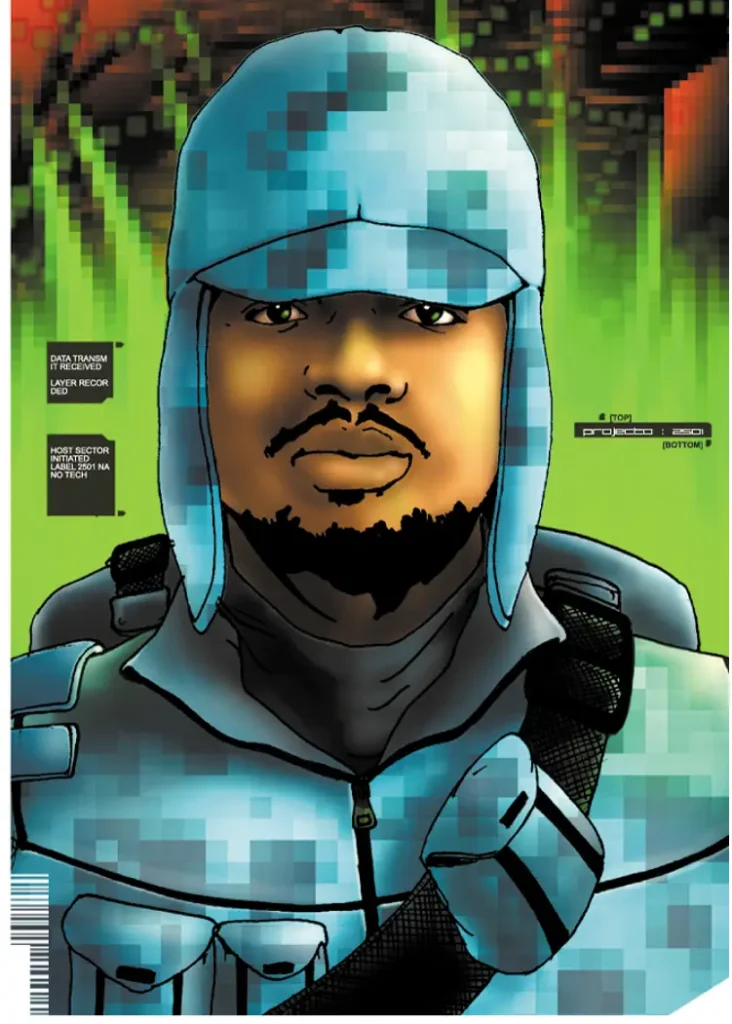
Tech Stack
How did this album get done, technology-wise? Were you making tracks and sending Tajai discs?
Y: Yeah, it’s all long-range type.
What are you using—what’s your studio?
Y: Um…I don’t want to give away too many key elements—the ingredients of Coca-Cola or some shit… But everything was arranged and produced on the PC.
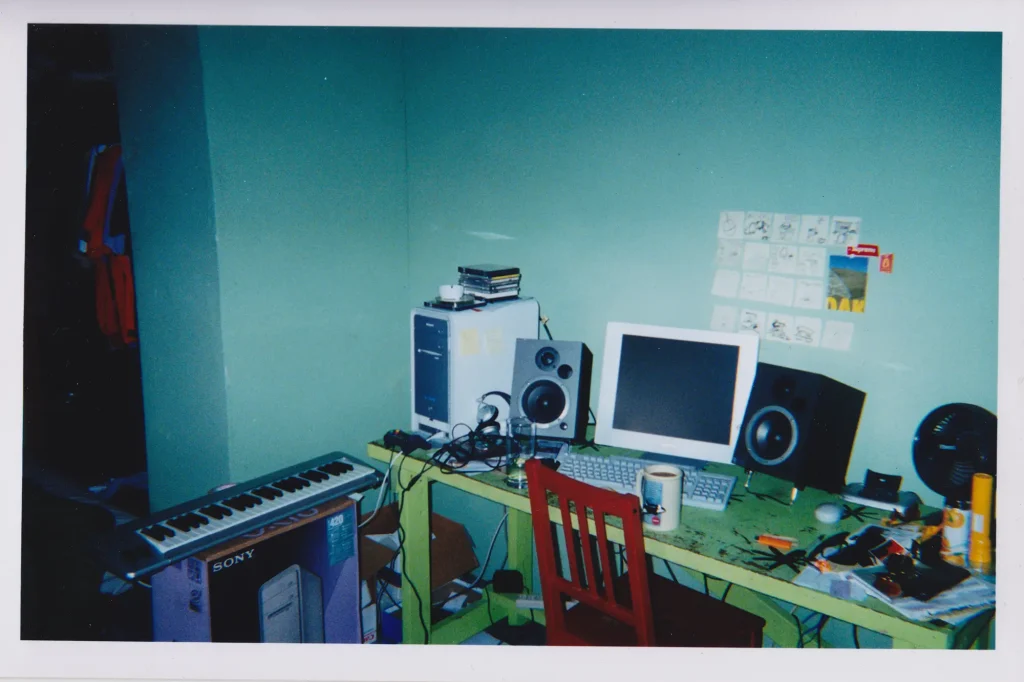
T: He would burn a CD and send it to me, and I would track it on ADATs—just track it digitally—and then put vocals to it.
Stylus
Did you have your rhymes in mind already before Yameen sent you the music?
T: I sit with the beats for a looong time. There are so many elements, you have to have a framework before you just do a song. So, I sit on the beats for a long time. And then execute it.
Y: We kind of knew where we wanted to go when he said, “Let’s do a whole album,” so I took the beats I had and added additional vocal elements to them to push the narrative along.
At that point we didn’t really know where it was going to go, we had no concept of the characters or anything. But we knew our theme or motif based off of “Authentic Intelligence.”
We wanted to embed a sort of…sinister overlook of technology. So I found vocal samples that related to that theme and placed them in-between each song to push the narrative along.
Projecto: 2501 is hip-hop with an eye on the future of multi-media and art.
– XLR8R
Multi-Verse
How do you feel about the immediate future of multimedia and music? About music starting to incorporate visual art and different artistic elements?
Y: I’m all about immerse worlds, that to me is like second nature. That’s how I have always perceived it. Especially coming from all the web design stuff [as a web developer]. I don’t want to just make a web page, I want to make a whole world that people can come to and inhabit. It just seems normal for me to do that.
Nowadays, I can make a DVD on my computer. That technology is now readily available to people [ed. note: DVD technology was released just a few years earlier]. Now that we have so much creative power and control over the technology, we can basically do what we want, artistically.
It would be dope to take everything and make it more interactive. I feel like Tajai and I are moving in the right direction introducing trading cards with our album: just sucking people into this world we created, as opposed to them simply listening to it.
Obviously the music is also very immerse by itself, but combined with those visual elements, it’s another step further.
Further maximizing the multimedia aspect of the project, five months after the vinyl release, Tajai and Yameen released the CD version of Projecto: 2501 on May 1, 2001, quietly including Enhanced CD features that were not officially announced until two months later, on July 1.
Cybersurfing Senses
We can make technology do what we want it to now, but maybe not later. It sounded like there was Chaos Theory going through the whole album. For instance, “We have shit in order now, but eventually it will escape our grasp.”
Y: I think eventually we’ll all just synchronize and turn into pure energy.
[Laughter.]
Y: We forgot how to telepathically speak to each other, we’ll eventually remember how to do that soon.
We knew how to do that before?
Y: I think so.
T: And they’re trying to develop it through technology too, you know? Like trying to develop an eye that plugs into your brain and sends a signal so they can make blind people see. It’s only a matter of time where they’re going to be able to put this electrode here or there. I think they even have computers now that can read your brainwaves?
I don’t know what the saying is, but we’re going all the way around to get over here. But maybe, eventually, we’ll be able to develop our own senses again to where we can do all of that, through the use of technology.
People have this idea that technology is what is making it possible, but the raw materials are out there. All the technology is doing is channeling it.
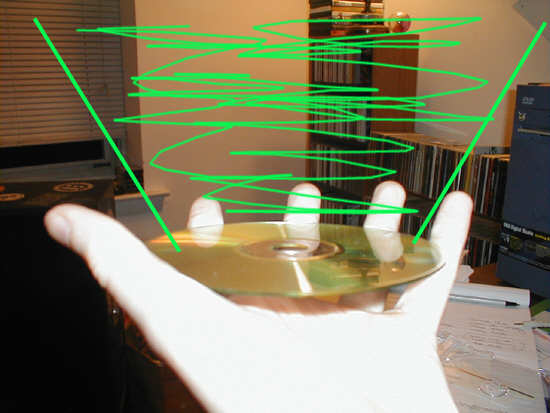
Y: DNA too has a big part of what is coming up. To truly cybersurf, it’s like…DNA is strictly information. And now that they have it mapped out, you can turn it into binary code. And then when it’s in binary code you can upload it to a computer. So theoretically you can map out your DNA, upload it to your computer, talk to yourself on the computer and be like, “Self, go get this piece of information.” And it’s like, “Alright,” and jumps on its surfboard and surfs the net.
And maybe that’s when it “clicks” and gains consciousness itself if it doesn’t already have it.
[Laughter.]
DigiDestruction
Damn, do you think it can go too far though?
Y: I mean, what’s too far?
T: Yea, that’s the real thing: What’s “too far”?
It’s the use, not the technology. Like nuclear energy is energy. We just decide to make bombs with it. To me it’s a matter of use.
There’s got to be some sort of — I don’t want to say human, but — spiritual kind of element that governs the way we use these things.
If you come across an energy source that’s almost unlimited, and you decide to make bombs with it, then there’s something that…If you want to destroy that bad, there’s something wrong with you.
The use, you can’t go too far with. It’s the application where you can mess up. But hopefully when people realize we have this power it’ll be used for — I’m not gonna say good — you know what I mean? It’s all abstractions when you get to that point. When you’re splitting atoms and shit, even, you’re just like, damn…
Do you think technology will be able to encompass that spiritual affect?
T: I think that’s where the human/animal/natural element comes in. But, I don’t know…It’s too hard to determine.
I mean, look what we have done so far: everything we have done so far is kind of fucked up, so…
But we have this long body of information that says, “Yea this shit is fucked up,” so we know, damn, we’ve destroyed this, we destroyed this, we know how to destroy this, we can get here and blow this up. So maybe we’re going to be like, “Let’s start using this for other reasons.”
Or maybe we’ll be able to travel to places where we say to ourselves, “Damn we can’t fuck this one up. Let’s do this one right.”
But that’s what a lot of people were saying about the digital age, like OK this is our chance to start over: take the technology and do it right this time.
Y: But even so, now that everyone has all this freedom and access to information, they’re trying to govern it and create laws.
T: Make money from it, really….No free email?? I mean that’s just dumb!
But that comes back, again, to the human restriction of technology, or efforts to try and box it back in again.
T: It’s too late…
[Laughter.]
T: Just look at the idea of a hacker: like pirates and the open seas. And these seas are vast and the hackers could control everything that we use.
It’ll be crazy when they start hacking into satellites. The same way Orson Welles did the thing with the radio and said aliens were attacking? Somebody could produce a film of an alien attack, upload it to the satellite like it’s The News and broadcast it and just scare the shit out of everybody.
I’d like to see that actually.
[Laughter.]
Buffer Overflow
Do you think there is such a thing as having too much information?
T: At one time, yea.
Y: But if it’s stored and readily available, no.
T: You just have to get it at the right time. If not, you’ll be crazy. Most of the people that are crazy, that is probably what they are suffering from: too much information at once. You know, someone will be like, “THERE WILL BE….MACHINES! THAT FLY! CARRYING PEOPLE ALL OVER THE WORLD! AND THE EARTH IS ROUND!”
[Hysterical laughter.]
T: THE EARTH IS ROUND!!
Paranoid Android
I think a lot of people have that fear of technology, though, much like if you said the earth was round back in the day you would be burned alive as a heretic. Some people don’t like computers or some people think computers are cool but don’t fuck with cell phones…
Y: It’s the uncertainty factor. They don’t know what it is or what it could do; therefore, they’re scared of it.
T: It’s kind of healthy. Caution is healthy, fear is dumb; there’s no point in fearing it.
I can foresee stuff getting out of control. Or maybe it’s already out of control and we just don’t know it yet. But, this stuff is readily available and it’s about the use. The information is there.
Just like the idea of tapping into different parts of our brains to use telepathy: our brain is not different. Maybe 20, 30, 40,000 years ago it has evolved since then. The hardware’s still there, we just don’t know how to use it — 89% of it, so…
The information being there, that’s the raw material. It’s what you do with the material. And that’s what is really scary to me.
What we have done with the materials so far is make weapons, that’s it! Make weapons and make a money-based system and people will hunt after money instead of — not things — but real shit. People are content to be billionaires, like, “I’m a billionaire. I can’t ever possibly spend all of this money, but I have it…Somewhere….On paper.” People be millionaires on paper and be happy with that.
Right, but nowadays, the tech millionaires, according to all the 1’s and 0’s in the bank’s database, they’re millionaires but tangibly-speaking they don’t have much.
T: Yea…When that busts? That’s going to be crazy. Because we’re going to feel it out here [in the Bay Area]. All these houses that are selling for ridiculous money, they’re going to be foreclosed. Unless they pay cash up front…Right now. Even then they may not be able to cover the taxes. It’s going to be crazy. This area, the Bay Area, we’re going to feel it the most.
If existence itself is a part of fate,
– Shing02
then is our music merely a faithful reproduction
of a completed work
from future dimensions?
Electronic Music
How about the technology of hip-hop music? A lot of the music is still made on old-ass technology.
Y: Hip-hop has always embraced technology. We even went so far as to make our own technology to do what we wanted, like the turntable mixer. Hip-hop is no foe to technology.
Tajai and I were just talking about advances in music like digital recording and MIDI; ripping open the void of what artists can now do in music. You can make music out of anything, you know? It’s whatever you have access to, you can make music with.
T: As far as hip-hop, it’s always been technological music. It started with the DJ: the turntables, then the mixer, the mic, sound systems. There’s hip-hop bands too, but even they use technology to add to their sound.
I don’t think with most music there is a fear of technology…Classical is perhaps the main human-powered music. But the idea of needing a big hall for the right acoustics, you need technology to build an enclosed environment like that. It’s just going to continue. And I think more stuff will be regarded as music too. Like crickets and things.
Y: What I like about it is how many sub-genres hip-hop has spawned from its technology. I would even go so far as maybe calling hip-hop, “Electronic,” know what I mean?
T: It always has been, really. Except for like the cipher and beatbox, you know what I mean? And that’s like the raw form. But you’re not going to get on the stage and start to huddle around…
[Laughter.]
It seems to me hip-hop has changed the way other forms of music are made. Pop music nowadays, they make it like it’s a hip-hop record. Which is weird because Pop musicians have million, million dollar budgets. But still they sit down with the hip-hop producer guy and make a beat.
T: Add some scratches…
I mean, hip-hop has changed the face of a lot of music, but you have to look at Reggae before that. Listen to The Police, they just made reggae songs and added a little rock to it. Even hip-hop culture comes from Reggae: just the sound system, and the idea of dub and selecta, and all the crazy air horns and sounds. They build from each other. They build a lot from each other.
But it’s not linear, it’s like a web.
The world wide web.
T: Really! It’s just “soundface” instead of computer interface.
We really travel the planet — it’s the same crowd even — because of these sounds…and that’s crazy…
Performance Enhancement
Speaking about traveling, is there going to be a Projecto tour?
T: We gotta figure out how we’re going to do it, man!
Y: I want to get a robotic ant that comes out with the turntables on the top.
T: I wanna be on a screen or something, and be backstage rhyming to a camera, with just a face on the screen on-stage.
[Laughter.]
Like some Wizard of Oz shit.
T: Yea, and just have the shit be tweaking with camera effects. But it would be just a big face on the screen.
I want it to be live, but when I say certain things maybe images pop up behind the face…I’m there [at the venue]! I’m just backstage rhyming to the camera.
[Laughter.]
T: We want to get some chapters done in the whole saga first, just so we can have a lot of material to draw from. So it would justify going and doing the whole shit.
Y: And it would be on ice too.
[Laughter.]
T: Choreographed, have some bunnies on ice!
That’s trail blazing right there, man!
T: Even project the face onto the ice…
[Laughter.]
T: There’s some shit you can do, dude…
There’s a lot of technology available. But it starts at the music.
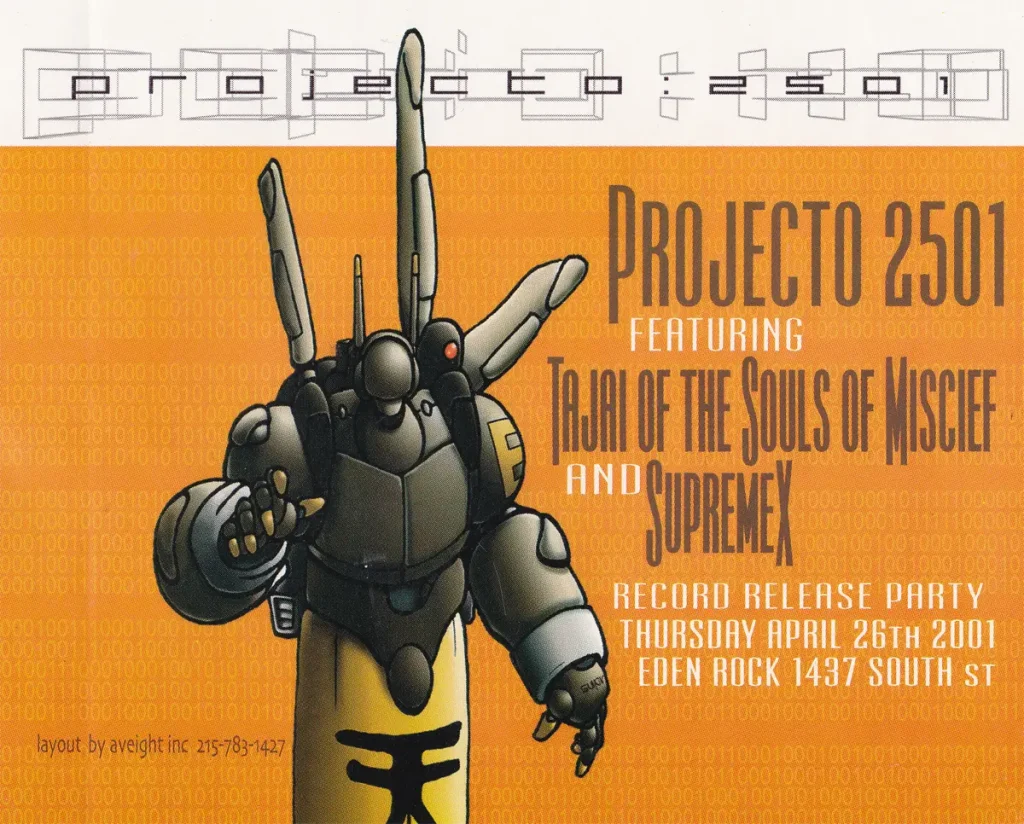
Projecto: 2501 is available for streaming and download, or you can pick up the Enhanced CD.